Showing posts with label based on a true story. Show all posts

Thursday, September 8, 2011

Alive (1993)

Perseverance in the face of an accident

This was based on real events about survival and holding on when an impossible event, that includes friends and loved ones, causes others to make decisions and sacrifices that they would have never done before in their comfortable lives. "Alive" wasn't made to be an action/adventure story in the wilderness but more of a drama that concentrates on the people and the emotional impact of how far they had to go to hang on.

In 1972, a plane carrying a Uruguayan rugby team and other passengers are passing through the Andes mountains for a match in Chile. Everything is fun and games with the world in the palm's of their hands, until they choke up when going through a rough patch of weather. Before everyone knows it, it's the real deal as the vision of the pilots gets blurred by the atmosphere and they clip a mountain top before crashing into the freezing, snow covered terrain. A share of the passengers flew out of the plane before impact and then there are those that are injured or dead when they abruptly stop, luckily without explosion (see Hollywood, not everything is combustible), but still with a wrecking impact of toppled seats and contorted passengers. Various wounds and psychological trauma runs rampant and those that are better off scrounge up supplies till they can get rescued. Communications are out, temperatures drop at night and food is scarce among the remaining at that point who use the somewhat intact fuselage as a shelter.

The captain of the rugby team, Antonio (Vincent Spano), keeps everybody together with a game plan and reassurances, until matters get worse when they think they're going to be rescued and the remaining food is quickly gone through. Roberto (Josh Hamilton), who was attending medical school, acts as stand in doctor after their team physician died, along with his wife. It becomes a test of human will and endurance as the days pass by with little hope in sight but what they make of their pitiful situation. They see how hard it is to trek even a small ways as young and athletic as they are. A man named Nando (Ethan Hawke) isn't taken seriously at first when he boasts that he's going to go out on foot and then eat the flesh of the dead pilots for sustenance because they were the ones that got them in the situation in the first place. Desperation hits with bad news from a hand held radio. Nando tells all his proposition and it's taken mostly with disbelief and derision. "I don't think I could do it. How could we go back to our families?" "You could go back alive. I think they'd prefer that." "...are you ready to go out there and cut flesh from a human body and eat it?" "It's like communion. From their death, we live."

The story and events gradually unfold as you get a feel for the passengers. The simple things are shown as they bide their time with song, prayer and idle talk to stick together as a unit. This comes with some emotional scenes but it didn't seem like they set out to make this a through-and-through tear jerker. There's some humor and other areas where they have to push their feelings aside for the time being if they want to keep going. They first go through a crash, battle starvation and then if that wasn't enough combat acts of nature. A few take a trip to retrieve a battery from the detached tail end to get the radio working to call for an SOS. Though the repair work was harder than it looks and this time they plan out an impossible journey with only makeshift equipment and a desperate hope to get help for the rest who are deteriorating in health and spirit.

Their English at first might seem somewhat formal in areas, but my guess is that they phrased sentences how it would be closer to Spanish. Thus despite U.S. actors, they didn't include any blatant Americanisms in their speech. Still, some parts come off as a little forced and unnatural when trying to convey the array of emotions that the real people felt, but, on the other hand, I'd imagine it's better that the actors performed somewhat unpolished to show spontaneity to the situation rather than going with clipped dialogue delivered from a comfortable movie set. They didn't lose sight of the real events with a distracting amount of poetic license--even though there are some aspects glazed over for the sake of narrative as well as handsome and recognizable actors in place of the real people--it sticks close to what happened. The rescue attempts aren't shown and it's kept focused on the people at hand. The '70s version "Supervivientes de los Andes" used a framing technique to show the government working to find the plane, but it was spaced so far apart to lose its driving power. The after isn't shown beyond a brief but rewarding scene, but, then again, it shows them as a connective group by my guess to not single anyone out as a lone hero--for which Nando in real life says he's not--not to mention this is a means to point a viewer towards another medium and serve as the audio and video introduction.

There are some enthralling shots of the scenery with a landscape that has seen countless days, months, years and seasons, as well as generations of species pass by and still to continue going on well past the mentioned's lifespan. It goes to show that nature can be both beautiful and treacherous, even when people are caught in the middle. It makes no judgments, which gives thought to wonder if it should be studied, feared or awed--probably a combination of all of the above.

Rating: 7.5/10

Director: Frank Marshall (Arachnophobia)
Stars: Ethan Hawke, Vincent Spano, Josh Hamilton
Link: IMDB

Wednesday, September 7, 2011

Supervivientes de los Andes (1976)

No vegetation or wildlife...just your amigos

Based on the book "Survive!" from '73, this was a Mexican made film that quickly jumped in for the cinematic experience of real events that happened just four years prior in '72. The story involved a group of people that after an accident had to make impossible choices for their survival that they would have never done otherwise. To take that even further, this was a special set of circumstances that would more than likely never be repeated by someone else again. Both this and the much bigger budget version of "Alive" in the '90s show how the main events occurred similarly, with some minor scenes emphasized more than each other. However, "Alive" was the more dramatic and captivating version for the visual experience and for an introduction to how some of these people made it out to tell their harrowing story. "Supervivientes de los Andes" didn't capture the full effects of the events, with the exception of some grisly bits that were amped up in marketing tactics for the U.S. dubbed version called "Survive!"--which has a different running time and some other alternations. Shock value sells, and it makes you wonder about "Soylent Green" coming out a year later after the Andes' events with its final twist that wasn't in the original novel it was based on.

Goodbyes are said at the airport with a group of young rugby players and other passengers from Uruguay on their way through the Andes mountains in South America. There is some foreshadowing dialogue in the beginning as if the characters had an intuition for what's to come; that or for a wink-wink to those who already know the story. In the air, weather conditions and confusion on both of the pilots' behalves causes them to crash into a remote area of the mountains where there isn't any vegetation or wildlife and the temperatures are freezing if that wasn't enough. A share are dead, others are injured and the rest try to overcome the harsh and snowy conditions with little provisions. They attempt to stay warm in the remaining portion of the plane, though get at each other with in fighting, until they realize they have to stick together as a union. What originally started with 45 passengers at the outset begins to dwindle with lack of food and slim chances of a rescue attempt. They're losing hope and starving, though soon enough one of them propositions they eat the meat on the dead bodies so as to remain alive.

The avalanche scene--which killed more of their party and in real life caused them to be held up for a few days--in the movie is over and done with in an abrupt and brief scene, causing it to lose much of the impact and then only revert back to shots of cannibalism. I found it to be one of the more emotional scenarios they had to go through because they were so beaten down by that point that it caused the remaining survivors to reevaluate their chances all over again. Their health is failing and they realize a trek with a selected strong few is their only chance out to save the rest. Towards the close it gets a little too drawn out with anticipation before the final pay off. After seeing how down and desperate they were beforehand, the viewer is dying to see some resolve by that point. There's a framing technique with alternate shots of a rescue attempt, not just to detail that they tried, but to make it somewhat of a driving point. However, it comes off as anticlimactic with too much space between the shots of the survivors to put the audience on the edge of their seats.

What's disappointing here, is a share of the transitions between events feel as if they're laid out like a formulaic storyboard, while missing out on some of the emotional impact of the real occurrence or even how they got from one action to the next. In theory, things are bleak and hopeless as they sit around, but it feels like watching this from a distance with the screen still blocking contact between you and the characters. Sometimes the performers don't feel as individuals rather than a general group, therefore there's more concentration as an overview than on specific character's thoughts or their interpretations and motivations. Watching this now or in '76, doesn't always do more than a written account, as the audio and visual cues to translate the events aren't always done justice here. There aren't any memorable performances as a result that stick out--with the exception of the fathers trying to hold on despite not being extensively shot--or even stand out acts of the dramatic, and it can make the story turned into the cinematic experience feel somewhat flat. The production values range from makeshift to just meeting the grade. It comes with some model airplanes to make one stretch their imagination, as well as not so convincing snow sometimes thrown this way and that when they're filming the fuselage on what looks to be a sound stage with actors missing icy breath. Other shots of the surrounding outdoors appear to be filmed on location and give it more of the realism of being there in the barren surroundings. This has some stock sound effects, such as a looped wind effect that becomes tedious after a while, and even some cries from the characters are overdubbed.

This is kept simple in some areas, yet it switches over to show some candid shots of eating flesh of what's supposed to be humans, not to mention cutting it off and laying out strips so the survivors can economically munch their portion. My guess is to curb fighting over it and keep it civilized. It's somewhat shocking as the camera doesn't pull away even when the point is made, but they also didn't kill to eat or do it in a way that's rapid, which makes it more an act of human will to hang on for life and see your loved ones on the other side than something outright animalistic. From being backed into a wall, they were still conscience as to what they were doing to make it out: from first the plane crash without falling out or exploding, to the weather conditions, to their own bodily functions failing, to then having to trek through mountainous terrain. To point out, if any one of the those situations failed, they were dead, so focusing on the cannibalism portion does feel somewhat leaning towards sensationalism, though I'm sure the investors had to sell tickets for the morbidly curious.

Rating: 4/10

Director: Rene Cardona (Night of the Bloody Apes)
Link: IMDB

Saturday, August 20, 2011

My Sweet Satan (1994)

He served and died for his master...or so he thinks

The first time I saw this 19 minute short prior to finding it on DVD was around the early 2000s in a heavily bootlegged VHS tape through a fellow metalhead due to the soundtrack having a few extreme metal bands. At the time I thought it was just a low-budget exploitation piece but little did I know that it was based on the real life case of a 17 year old kid from New York named Ricky Kasso. In the film he's known as Ricky Kasslin and lives in Dayton, Ohio. Jim Van Bebber, who would go on to do "The Manson Family," would not only direct and write this but also step in as the main performer with drawn-on tattoos and a wild haircut--that looks in the way of Anthony Kiedis in "Point Break"--to show for his efforts at portraying this fractured individual who left a small stain on this Earth.

What works about this film is that it takes the perspective of multiple sides as to who was involved. There's enough room that a viewer can decide if they want to completely lambaste any and all involved, or be sympathetic, or possibly both. The devil worshipping aspect is brought a little closer to home and I'm sure can put a lot of people on edge. Yeah, occultists in old Hammer films with black robes and a certain precise order to their shadowy practices is one thing, but having an unsupervised kid running the streets and hanging out in local cemeteries is a lot more unpredictable and closer to your backyard. Except the film isn't mainly about that per se--even if it didn't hold back on the "praise Satans"--as it didn't try and show it was an epidemic that needs to have something done about it. It was a special set of circumstances that probably won't happen in the same way again. This is more about a delusional, misguided and rebellious kid who makes up his own rules and takes what he does to the absolute extreme, which ultimately leads to his end. Whether it would disobeying his parents and living on the streets, destroying property, fighting, doing excessive drugs, and then the main clincher being a quick but still brutal torture and murder over a prior dispute. One way of looking at it is he only lived 17 years on this Earth but lived it up by breaking whatever rules and deemed morals he could. He'll never see tomorrow, but what more does tomorrow hold in store for him?

The production values aren't stunning but this makes it a little more realistic that there are all unknown actors, real locations and natural mistakes. The acting is the equivalent of the public broadcasting channel for all those that are just used to fancy Hollywood movies, and the picture quality looks like somewhere in the '70s despite obvious trends in the '90s running rampant. Regardless of what comes out of their mouths everybody still looks the part. The atmosphere in this short essentially captures what was apparently going through Kasslin's head. The story is pretty straightforward but there are still various shots and snippets of dialogue to get a feel for his demeanor, motivations and lifestyle. There's some narration overtop to explain what the people were thinking at that time and how they would have done it differently after the fact. It goes to show how someone can get caught up in something without even realizing what they're doing because they're so directly in the moment.

Rating: 7/10

Director: Jim Van Bebber (Deadbeat at Dawn)
Stars: Jim Van Bebber, Terek Puckett, Mike Moore
Link: IMDB, Real life story

Tuesday, August 9, 2011

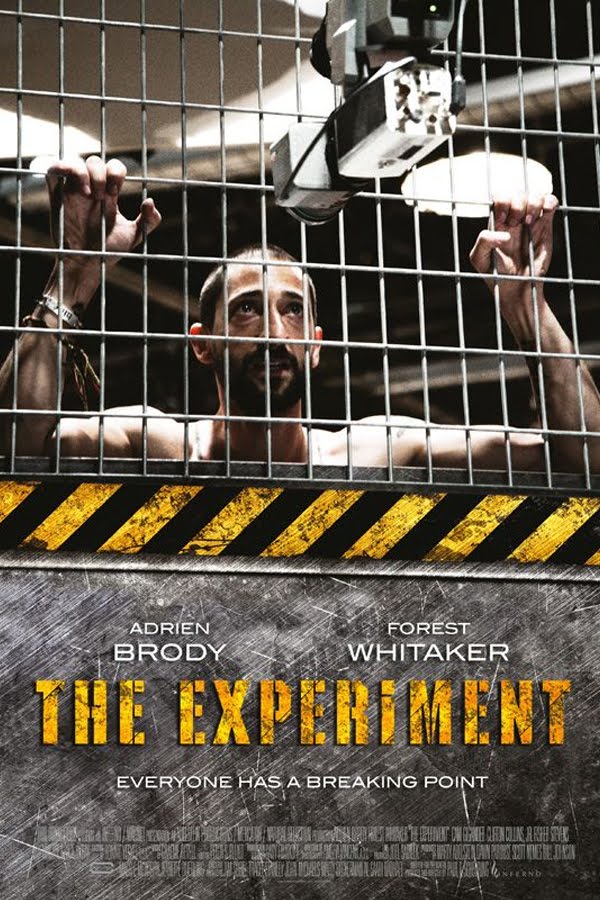
The Experiment (2010)

The power hungry, the pacifist and the conformers

This is a film with a message about losing sight of what it means to be a civilized human being in modern times and if violence should equate into our decisions and motivations when interacting with each other. It goes beyond the usual white lab coat behavioral experiment when an elaborate scenario is created that takes a group of participants, who want to make a chunk of change, by simulating the conditions in a state penitentiary for those who've never been in to demonstrate if power would be abused.

After Travis (Adrien Brody) gets laid off from a nursing home, he protests a war and finds love. She wants to go to India, he doesn't have cash, so he spots an ad in the paper offering $1000 a day for an experiment. How hard could it be? Soon enough the participants fill out paperwork (easy), get individually interviewed (sounds fun), put through visual tests (not so great) and then sit through an orientation with a speedy talker (show me the money!). He makes it all sound so "safe" and "secure," expect a clue comes when he slips in that some subjects will be deprived of their civil rights. Get 'em to say yes a bunch of times and anybody making a pitch won't have any trouble dodging that no. Off they go.

They're brought to an isolated location and are to be locked in for two weeks by themselves with only cameras to watch. The test subjects are divided into two groups of guards and prisoners and given specific rules that they must follow or else nonviolent disciplinary action is to be given from the guards. If the guards don't follow accordingly a red light will be turned on in 30 minutes and the experiment will be terminated resulting in no one getting paid. Some focus on the money and block it out. Others can't handle the stress of dropping what pride, beliefs and creature comforts they had beforehand. And then there are those that take it a little too seriously either because this is their chance in life to be taken so or they actually enjoy taking advantage of others when granted the go-ahead from a higher authority. Soon enough the weaker start to fall in line and the stronger step out in an attempt to stand by their points. Two personalities collide on opposite sides with Travis (Adrien Brody) representing the prisoner's rights and Michael (Forest Whitaker) helming the guards with no-nonsense, totalitarian order.

Part of this was based on the real life Stanford Prison Experiment conducted in 1971. However, there are some differences, as this attempts to show how it would have ended up if the head scientist wasn't directly involved in the decision making processes during the experiment, as well as it doesn't have him set a tone to guide a certain way. Results also happen within only a few days out from the start with here poor impulse control such as alcohol abuse, as well as gross humiliations, torture, attempted rape and a few of the guys might have been dictators in a past life with their penchant for well timed out speeches. Yeah, it's all going to seem exaggerated, not necessarily for what could be done, but how the specific scenes were set up as it didn't completely put the audience in their shoes and its believability starts to dwindle after more and more scenarios are stacked on.

It's strange to set this in modern times, as there are stricter ethical guidelines and background checks that would test for mental instability and diseases due to the original experiment. It made it seem like these trained professionals went out of their way to deceive and purposely show inaction to see results without actually explaining or showing why--by being kept completely in the dark, it almost makes them diabolical. Not to mention if there weren't several dominating personalities in guard positions (which seemed to be purposely put there)--or even prisoners who took it seriously at first, however you look at it--it's questionable whether this would have gone the same.

They didn't try and make this an exceptional case out of a bunch, but the only one tested apparently, which isn't enough to see if it was just a fluke. It seems over-elaborate to jeopardize their professional careers as there are now established rules in place; as well as for the sum of money they were giving out and the design of the facility to put all their eggs in one basket. It also only shows how a set of people temporarily put in authority positions will react in the heat of the moment resulting in their perspective being off to find a reasonable middle ground--rather than in a real and established prison system that would have a guideline in place from an extended period of trial and error.

The ending winded down a little too easily as they were well behaved going in, animalistic inside, then instantaneously regretful, so the filmmakers could quickly put the blame elsewhere for what the participants did. As a cinematic experience that goes for entertainment value alone, "The Experiment" has some particular areas where the actors shine, has a steady pacing that wasn't in one area for too long, and it still left room to think about some "what if?" questions even if it seemed to have somewhat of an agenda that leans towards a certain side at points. Though it's a movie where more of it seems fine at first as everything is happening so fast, but when the brain settles down afterwards too many questionable things occurred and it might make one's head spin more than inspire productive debate.

Rating: 3/10

Director: Paul Scheuring (producer/writer of "Prison Break")
Stars: Adrien Brody, Forest Whitaker, Cam Gigandet
Link: IMDB

Saturday, August 6, 2011

Downloading Nancy (2008) - 3 of 3: Internet Death Fetish Trilogy

At wits end

When the printing press was invented it spread media quicker and farther than ever before. Fast forward to the information age where written documents as well as ways of communicating went digital from the invention of the computer and then a way to connect them to others: The Internet. Writing letters turned into e-mails and inked articles went way of text on a blog. This story uses the modern way of communicating and connecting to others but as an outlet for darker reasons rather than opportunity or forward outlooks. And what makes this tale so haunting is that is was inspired by real events with some cinematic liberties altered from a 1996 case about a woman named Sharon Lopatka who went by the name of Nancy over the computer.

"Downloading Nancy" is about a down-on-this-world woman, played by Maria Bello, who searches for someone on the Internet that would take her life as she's tried herself with scars to show for it. Not to mention going to therapy sessions to resolve her long list of deep-rooted issues without any substantial luck. She's married and unable to have kids due to being abused and suffering physical pain as a little girl. Her husband Albert, played by Rufus Sewell, doesn't understand her need for infliction during intercourse, and after 15 years of marriage is fed up with her immature and selfish ways of dealing with problems. He has golf and other hobbies to keep himself distracted, not to mention they sleep next to each other, yet are worlds apart. Nancy finds her guy, or so he says, and takes off with only a nondescript note left over to her husband. The newly met man from online seems the perfect match to give her the rough stimulation she feels she needs. Nancy has her highs and lows, from emotional to withdrawn, giving a torn decision to the man who's now infatuated with her.

Slow, serious, subtle, "Downloading Nancy" builds up by showing rather than telling how this woman got to the desperate, manic, end-all state she's at. There are loose, hand-held camera shots that put you there. Sometimes hiding behind something to give the point of view of witnessing and experiencing it first hand. The settings are dulled with drab colors and neutral furniture to give an oppressive tone without overdoing it and trying to be creepy. Maria Bello does an excellent job of playing a pessimistic woman with more than one troubling issue to contend with. Her impulsive ways make her unpredictable and unlikable, though there is a feeling of pity as she can't even help herself.

This doesn't have the typical amount of hope or resolve that you see in Hollywood pictures, but it's filled with real feelings of emotion that radiate from the screen. The film doesn't have any good guys or bad guys, and it isn't a horror tale as it won't happen to you due to both individuals being willing participants. It just unfolds this strange tale of how the Internet brought these two together, who would have otherwise never met as they're several states over. Though Nancy had stacking problems that were becoming too much to handle, and this was her way of finding an answer to solve it all by including this man to take charge of her life without question. The amount of blind trust she put into him might say more about herself than him. (If you missed 'em see my profile and click chronological for first review "Grimm Love" or the second "Cannibal.")

Rating: 9/10

Stars: Maria Bello, Rufus Sewell, Jason Patric, Michael Nyqvist
Links: IMDB Real life story

Cannibal (2006) - 2 of 3: Internet Death Fetish Trilogy

Once opening this door, it's impossible to shut behind you

This reminded me of a two man version of "In the Realm of the Senses" in regards to focusing primarily on the physicality of a relationship than a layered story or strict narrative. Going with that, "Cannibal" is probably THE most twisted "love" drama out there in the wide world of cinema. While it doesn't succeed in the normal sense, it's a film for most that is going to be incredibly difficult to watch, not because it's overly sad or intentionally going for terror, but because as you're witnessing the bizarre events unfold you realize this was based on a real life encounter between Arwin Meiwes and Bernd Jurgen Brandes of Germany only five years prior to the film being released. The filmmakers included their own poetic license but left the rest up to our two friends to fill in the rest with their piece of strange history committed.

This is paced very slowly, at a purposeful rate and with extremely tight close-ups to the point of where it's hard to focus on what's going at moments. Communication wise, this goes for subtlety and tone rather than a reliance on dialogue. The music gives more mood towards sentiment than ominous overtures to come like in a typical horror movie going for suspense. This definitely has the potential to be shocking but the filmmakers leave that up to the viewer, as everything is shown point-blank, as is, no acceptance or dismissal of it: it was what it was. I found it downright uncomfortable, as it plays on odd and unfamiliar fetishes between two men that includes frequent kissing, fondling, tender touches and insertion. Not to mention it treats the material extremely personal without a hint of cutting away. There's no break here, except if you count dining on some privy body parts, lounging around completely nude with unsightly appendages dangling this way or that, or soaking up the sun while feeding a garden with left over human remains.

This won't make tops of lists of items to watch again, nor is it a film to invite others over to see with you. That is unless you've got time on your hands with some explaining to do, or you're playing a daring game of who can keep their eyes on the screen longest without covering up or looking away. It's hard to call this a "good" film. Though in the basic and unconventional framework that it delivers in it's an effective one. I haven't had to take a break when watching a picture since seeing "Salo"; this is even over no story exploitation pictures like "The Devil's Experiment" and "Aftermath" where I've killed a party and had other people leave the room, never to let me put on another film again. I can't say I agree with anything I seen here but the filmmakers were able to display a certain event without even having to inject little horror-like scares, but by just showing the audience what happened behind those walls that you'll wish never came down. If you didn't take the hint: get out now. This isn't scary, as you'll probably win the lottery and get struck by lightning in the same day before it happens to you. Except for maybe giving hope to those strange folks who's irregular interests stunt dating, the regular viewer won't be put in their shoes and there are no real relating points that are emphasized here, such as with the movie "Grimm Love" about the same subject and the whole sentimental approach and look into their background.

In the end there isn't a big purpose as it leaves absolutely nothing to the imagination, guy soiling himself as he's missing his member and then leaking out the other end as he's dying and all. They squeezed in some tie-ins to "The Brothers Grimm" for some ambiguous meaning that seems a lost cause, though it doesn't appear like there is anything to ponder about here, except maybe why they would do this with each other and have the other one so willing to be a participant, or even how two guys like this lived so close? Is it just a modern thing, is the Internet the accelerator? There aren't going to be any heroes or villains, story arcs, layered surprises, just a non-stop candid look up to, during and briefly after these mens' interaction. Nothing fundamentally more, nothing sincerely less.

Rating: 6/10

Stars: Carsten Frank, Victor Brandl
Links: IMDB, Real story link

Grimm Love (2006) - Part 1 of 3: Internet Death Fetish Trilogy

A heavy-handed sympathy piece

This was inspired by the real life case of Armin Meiwes who put an ad over an Internet site looking for a willing victim to be slaughtered and their flesh consumed. What made the case so unusual was he was not only serious but another man named Bernd Jurgen Brandes obliged apparently without being physically forced as a share of the event was captured on videotape. "Grimm Love" is a tale that paces as a dark narrative drama with a fictional college student named Katie Armstrong, played by Keri Russell, returning to where these two lived in Germany in an attempt to get inside their heads for a research paper.

Instead of concentrating on horror and shock, the filmmakers switch back and forth between the present with Ms. Armstrong and also in the past with the two men who eventually meet up in a kind of twisted, interconnected fate. Oliver (based on Meiwes) is shown as far back as adolescence with his father leaving, trouble fitting in at school, as well as having no life apart from taking care of his ailing mother. He's alone and looking for companionship, though his way of connecting with people isn't hugs, kisses or long conversations, but instead a longing fixation of consuming the flesh of someone special to feel stimulation and closeness.

Simon (based on Brandes) is a homosexual who fears showing his feelings in public out of misunderstandings and ridicule. He has severe depression and searches for a sense of belonging through some normal and not so normal ways. He looks at extreme fetishes on an Internet chatroom as a way of feeling alive from a life that never accepted him. In 2003, Gay Chinese actor/composer Leslie Cheung was successful but still committed suicide by jumping off a building, likewise Simon also has things going for him, though it's too much and he wants to meet his end with symbolism that directly "severs" ties with his burdensome sexuality that gives him a guilt complex from his mother's suicide at an early age.

Dodging the pulse-pounding route of "Silence of the Lambs," this comes across more like "Kalifornia" by hearing the thoughts and experiences as they come through with narration. It also flows as slow as Cronenberg's "Spider" in an attempt at an on-the-surface character study of these atypical individuals' thought processes and motivations. Though the college student's montages about how these two men affect her take up extra screen time away from finding out more. There are metaphors and poetic wordings interspliced to sway the audience towards deep sympathy for these two fractured individuals. Sometimes making you think with introspection, but at other times being desperate to make a point and forcing their way in, like some of Keri Russells' obvious voice overs instead of letting the camera do the talking.

"Grimm Love" isn't going to be like watching a biopic on the History Channel by just stating the events as is, as the filmmakers are doing select reporting to be more convincing towards a certain compassionate, sentimental way of thinking than letting your own thoughts flow free. To some it's going to be touching, to others it's going to be sympathy for the devil. The heavy leaning towards the first here can take away from the experience as it feels written with a prior agenda in mind, not to mention before all things were considered in the case as the real events took place in only 2001 and an overturned verdict came in 2006 when this came out. I like the angle of diving into their background even if it breaks psychology down for the layman, though this would have worked better as a biography with anecdotes from relatives, friends and experts. Or if a story is to be had, something like the route taken with "Henry: Portrait of a Serial Killer," where the director of that film said he feels that he shouldn't have to decide a stance for the viewer, that that's up to them.

This isn't an exploitation film that takes advantage of real events such as "Men Behind the Sun" did, as it's more suggestive than showing candid nudity and bodily infliction like "Cannibal" about the same events. Though by the time it closes--right after the infamous scenario between the men that's akin to the real life events in "In the Realm of the Senses"--it can't seem to decide what it wanted to be. In the beginning and middle it was going out of its way to reason with the audience that these guys aren't just a couple of kooks with mental issues like the media sensationalized. Though by its close they left the story up in the air and ambiguous with the young woman being either deeply moved or having a change of heart. It makes me believe she was only included as a ploy for the writers to speak through her and then at the end decided it was time enough to let the audience choose. Not to mention at an inopportune time as it ends abruptly and doesn't show what happened next.

Rating: 4/10

Stars: Keri Russell, Thomas Kretschmann, Thomas Huber
Links: IMDB, Real story link