Showing posts with label country: Japan. Show all posts

Saturday, December 29, 2018

Urotsukidoji: Legend of the Overfiend (1989)

If sacred ground had an opposite

By: JWBM

The uncut version of this is one of the most over-the-top animes I've laid eyes on. It's one of those films that you have to double check not only who's in the room, but who will potentially come home and accidentally walk in on some of the scenes shamelessly displayed. Not only is it incredibly dark and violent, it's also perverted to another level beyond innocent fantasies: being at the far back of the mind of even the most demented person's imagination. Films such as "Violence Jack," and "Wicked City," set this up to knock it out of the park and run the bases two times over just because. One doesn't know whether to stick around, keep one eye open, or run for cover.

A large focus of this tale is of a foretold legend and what's to come from it for the three species of worlds: will better times be ahead, or will darker times swallow up any shred of light? Maybe a mix of both. There's a pull and tug between demons and humans, with the half-breeds to bring together a balance of sorts. Demons bring senseless destruction and chaos: from murder, and rape, to any other form of the heinous acts that go along with it. As far as they are concerned, things are just fine and dandy just the way they are. The more reserved half-breeds—while perverted, and just as capable of danger—are hanging on to a dream that the legendary Chojin will end up stopping the madness.
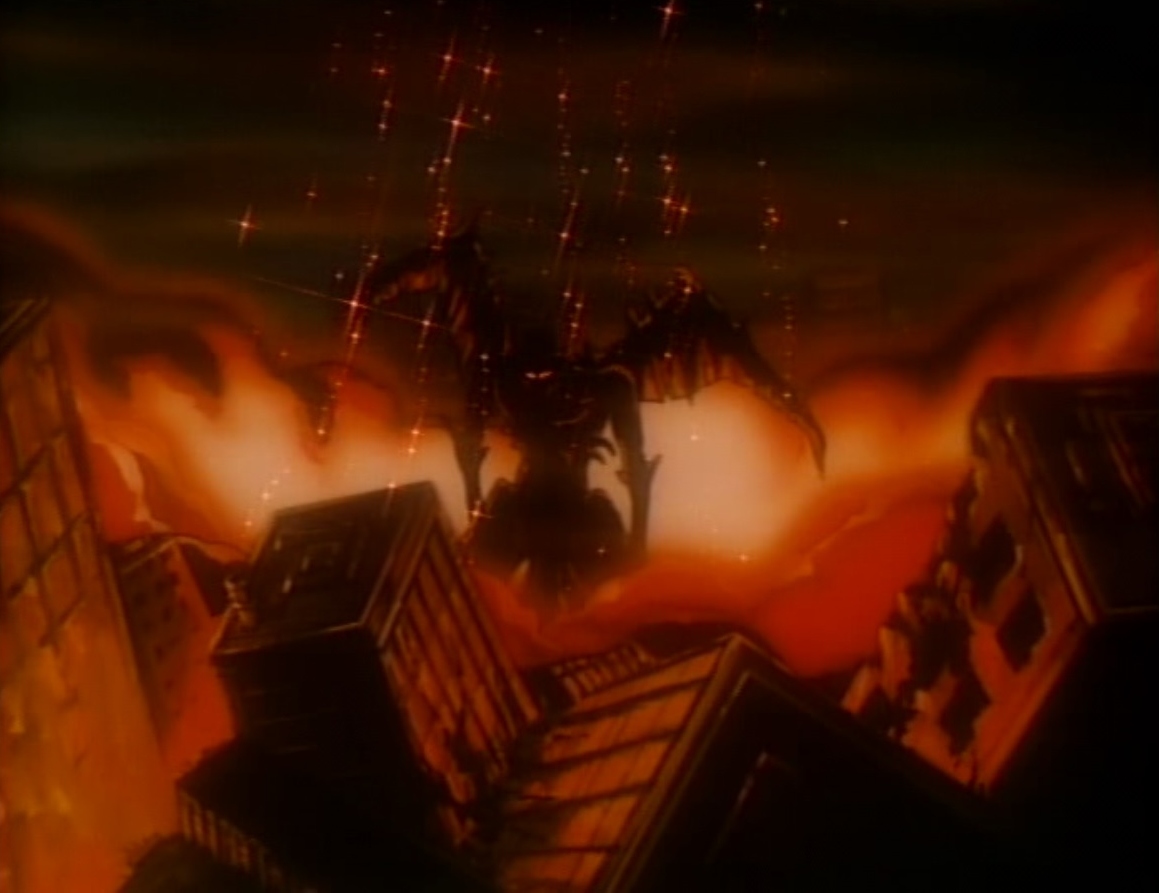
This is part fantasy, action, erotic, post-apocalyptic, coming of age, and also part horror. The tone shifts are sometimes at complete opposite ends of the spectrum: going from utter carnage and perversion, to light and fluffy teenager stuff. You'll witness scenes that will potentially leave scars for how utterly far they're taken, to then in the next breath have a kind of innocent high school love angle with sparks in the air. But, then again, that's what makes this work: if everything were painted black and red, the contrast would become monotonous despite its rugged edge. Needless to say, this is not for someone with a strict moral code. Take the scene with the nurse, turned demon, turned penis-arms taking every bit of advantage of a poor, innocent student behind closed doors. You'll never look at a nurse's office or even a predatory octopus the same again.

While the experience is one bounds-pushing sensation after the next, the underlying direction is not as linear as one would hope for. In some ways, it's a great collection of some memorably creative, perverse, and horrific ideas stirred up and let loose into the air. Some of the story—as simple as it is—does get a tad muddled at points with everything going on.  Also, a few of the character representations and voice-overs are somewhat awkward and silly, such as the two henchmen from the Makai world. Or the somewhat misplaced, cute, and perverted looking monkey thing that follows around Megumi: a half human, half demon with no sense of how a lady wears a skirt. Though, the first time I saw this, I walked away wide-eyed and with a few more check marks shy from my imaginary list of things I can say I've seen in the world. That seems to be the ultimate point here: to serve up a movie watching experience like no other you can escape into. "Urotsukidoji: Legend of the Overfiend" is what you get.

Rating: 8.5/10

Director: Hideki Takayama (Captain Future, Gu-Gu Ganmo)
Info: IMDB link
Trailer: Youtube link

Thursday, December 27, 2018

Fist of the North Star (1986)

Hope is not on the horizon

By: JWBM

As the dominant species with intelligence on earth, we often contemplate altering our genetic make-up to transform ourselves into more than our destined path would have been: whether that be holding on to our youth, filling our brain with more knowledge, or making every attempt to further our physical abilities. Now take the world going into a post-apocalyptic age, where those with excessive physical strength and ability become a chiseled symbol of supremacy. Men with immeasurable muscles and the demeanor of true scumbags, are now treated with genuine fear and almost like false gods.

We fight for food and water, we fight for mating rights, we fight for territory, and, at other times, we fight to see who's the best. With a little bit of all of the above, "Fist of the North Star" opens up to a testosterone laden world of sheer savagery with little end, and puts the weight of it on the shoulders of one man: Kenshiro. He's got a tragic past and scars to prove it, he looks like Bruce Lee had a kid with Mad Max, and, ultimately, he's got a certain genuine inner character balanced with an outer strength that might just be the key to saving humanity from the dark and nearly hopeless path it's headed down. 

What's interesting about this story is it's not saturated with drama of what we've become as humans, it mainly hovers around the primal portion of ourselves on either side: whether we've gone full dark and embrace chaos and destruction, or, in a more rare case, embrace trained violence for the sake of righting wrongs in a lawless world. It's essentially the necessary answer to most problems here; it's also unintentionally comical for how doors are opened, or any bit of property is treated, because at this point who cares. Psychologically, it resonates in the same morbid curiosity of not being able to look away from seeing two thugs duke it out on the streets from afar, to a bigger bully being taken out by a hero of sorts that steps in. I feel that connects with our deep-rooted instincts in that we don't want to admit it's there in this day and age of technological advancement and emotional suppression. Take for example, when was the last time you said hello to your neighbor, versus when was the last time you wanted to say something angrily to your neighbor? This uses the bleak and barren backdrop to take several steps back to where it all began.

The animation was fresh, creative, and original for its time. It makes the scenes pop, and the interactions feel that much more powerful. Some detailed painted backdrops are used to show the lifeless and soul-crushed state of the earth: buildings are a vague reminder, along with any shred of green or blue. Other scenes offer up wide-eyed surprises when it comes to the fight choreography and certain character's abilities. One of the coolest characters here is Rei, who has an ability to slice his opponents into a series of pieces in these atmospheric slow motion cut-away shots. An interesting note is the change in picture quality for the extremely gory scenes; apparently the original version was lost and then later spliced together.

This is a simple tale that works due to having an epic feel to it. Being a condensed version of a multi-part manga, there are portions missing in between that would connect the dots better, though it still maintains an emotional connection to the roles, along with manages to steer from being just a black and white approach to good and evil. This takes your typical fantasy story of fate and what's written in stone, and then inverts it from the unexpected and what was "supposed to happen." You'll want to either root for the anti-heroes, or possibly even transform into them yourself to serve up some crude justice.

Rating: 8.5/10

Director: Toyoo Ashida (Vampire Hunter D)
Info: IMDB link
Trailer: Youtube link

Wednesday, December 26, 2018

Baoh (1989)

An anti-hero with a worm for a brain

By: JWBM

For heroes and anti-heroes alike, the '80s were a breeding ground for one characterization to stand out with something more unique than the next upcoming sensation. Where "cartoons" were once known as an innocent means to bring about comedy or adventure, some were becoming more serious and story oriented. Material hit the shelves with the likes of "Vampire Hunter D" and "Wicked City": stuff so mind-bendingly violent and perverted that you'd have to hide it from your Sunday school teacher in fear that they'd discover the dark truth and deem you a heretic.

"Baoh" is akin to the next level of live action. It's not "Akira" level of sophistication, or what "Guyver" would end up fleshing out further with a guy with sudden abilities, but it's still where animation was learning a creative thing or two, plus taking powers and capabilities to another level of ferocity. Every other scene goes for a wide-eyed, queasy stomach hit to the senses and then some. It's your head in a vice tempting a messy fate with every skull-crushing turn. The story stripped down is fairly simple and pedestrian, though it's the punctuation put after it that gets the pot boiling to a roaring degree at points. Its mode of story-telling is to lunge for the throat, release, and then to offer up an explanation for the surprising outburst. In a nutshell: a government tested human weapon escapes the clutches of its masters and is then hunted down by an assortment of other powerful experiments in a series of bloody showdowns.

In what turns out to be its strength for the first half, also turns out to be its weakness for the last half without any change of formula. It's like a live-action music video: flashy, fastly edited, and somewhat hollow for story, but full of a share of creative angles and emotional impact. One moment its sense of mystery comes with fresh surprises, though there are points where it feels like it makes it up as it goes with more strange powers, and more random characters that pop out of thin air. It could have benefited by some duality to Baoh's or his master's character; even at 48 minutes, it doesn't have much for meat on its bones. In other creatures on the loose type of films you often get some kind of morality or sympathy coming from either side: from the creator with the best intentions that accidentally takes it too far, or from the monster having unparalleled power but not knowing the consequences of its actions. It makes it lack the inner workings to be more than a black versus white tale of I'll attack you, you attack me back, till one of us comes out the victor.

It still has a certain factor of coolness going for it, along with some memorably gory scenes to high five your friends to. Despite its quirks and straightforward nature, it's somewhat entertaining if you let your guard down and know you're only getting exactly what's promised. It's just not up there with other action oriented animes such as "Fist of the North Star" with a little more backbone and characterization to it.

Side note: If you're trying to decide which language version to watch. I'd go with Japanese with English subtitles. The dubbed English feels somewhat rushed and unintentionally eye-rolling at points. Though it's not without its charms if you've got a rowdy, voice-their-opinions group watching this.

Rating: 6/10

Director: Hiroyuki Yokoyama (Mobile Suit Zeta Gundam)
Info: IMDB link

Monday, September 3, 2018

Naked Blood (1996)

Blurring the lines of pain and pleasure

By : JWBM

"Naked Blood" in a way feels like a what-if scenario played out. It begins with its premise of a young, hopeful—though amateur—scientist that engineers a drug to make what was painful before, now feel a little too amazing. Just a pinch too much. Or a stab. You get the point. Then comes the setup of him giving it to a group of young ladies who think they're taking just an innocent contraceptive as part of a control group headed by his mother—who is also a scientist, but of the professional kind. This is low budget horror from Japan no less. There's carnage, weirdness, and some hidden symbolism thrown in for good measure. As you can imagine, this is not going to end well for anyone involved. That goes for the viewer, too. Some things you just can't unsee.

Is there such a thing as being in a state of pure elation? Pain and pleasure balance us, though steer it too much towards one or the other and a divide is broken. Too much pain and we lose our spirits; too much pleasure and we turn to simpletons who can't resist. The pacing sets up a slow escalation to create an obsessive atmosphere of eroticism, violence, and death. The film is littered with closest fetishes, not to mention odd interactions and reactions from character to character. That could also partly be the overall acting, which occasionally just gets by in a "We're just reading what's on the page and letting the story transport us from scene-to-scene" kind of way.

What the film does well is how it transitions to break down its boundaries. Bits of the story aren't always explained in depth. This just grazes the surface, which—in itself—keeps things abstract and as a surreal experience. There's also the other side of it that doesn't blink. The prosthetic effects and camera angles are full of close-up, gruesome shots and situations, where the viewpoint locks in tight and doesn't pull away till the last drop is spilled and someone is crying for more. With the home-video-like quality, it covers up some blemishes and makes them a little more realistic looking. It's creative and memorable with its gore and visuals. You'll never look at tempura, nipples, or even cactus the same again.

This begins as a tale of one young man's naive quest. As the journey is laid out, it looks like just an excuse to lure the viewer in to another exploitative dark alleyway full of dangerous characters and blood splattered walls. Though there ends up being some hidden messages written on the walls to the overall story arc that might be missed on the first viewing. I have my own theories, which can make it more of an entangling experience either way. It's not as out there as, say, "Tetsuo" as it starts out normal enough. Though by its finale, you still might keep the light on longer than normal pondering about what you just saw and how you're going to reason with it.


Rating: 7/10

Director: Hisayasu Sato
Actors: Sadao Abe, Misa Aika
Info: IMDB
Link: Youtube

Monday, August 27, 2018

Cure (1997)

Who are we really?

By: JWBM

Day to day we see people make mistakes. Their thought process at that moment was off for any number of reasons. Sometimes the advice or suggestions of others comes to mind before we make our next action. What if there comes a time when said suggestion goes against all moral and common-sense judgment, yet you feel compelled to do it anyway? As we often find out, doing something is often easier than dealing with the repercussions. Though if it's grave enough—such as murder—we'll have to live with that short moment for the rest of our lives.

Detectives are baffled. A series of killings are springing up around town that look eerily similar, except for the fact that the person wielding the weapon of choice is different each time. Meanwhile, one of the most unassuming villains blends into crowds in broad daylight and leaves behind little trace. How do you stop a killer who's not your typical killer? Detective Takabe heads up the investigation to put the pieces together and attempts to make sense of something that might never make sense to the general public. Meanwhile his wife suffers from memory problems and possibly other psychological issues. The amount of stress on this man's plate is palpable. Due to his professional position and his unwritten cultural code, emotional outbursts are kept to when he can't take it anymore.

The story dabbles with the deep rooted causes for committing heinous acts, building tension between our day-to-day interactions with each other, along with mental health issues. It's simple in premise, but ultimately relatable. Other films might just use psychology and an overly dark looking mental health hospital as a backdrop to strike fear into the viewer. However, "Cure" takes on all of the mentioned with a different approach than your typical crime-thriller bordering on horror. This is by definition a slow burn. It's reminiscent of a throw back to the early '70s—minus the nostalgic sideburns and splash of colors—but before everything got all fast paced and went straight for the jugular. The director, Kiyoshi Kurosawa, has a knack for letting the camera sit and the viewer to ponder about the entire set, story, and characters' interactions. That includes mundane, everyday things that are often overlooked, but now spark memories of terror. As a result, the pacing is hypnotic. It starts out innocent enough, but after a period you may not notice that its influence goes from soothing, to an itch, to alarming pain.

This feels more show than tell at times. They leave you with enough for some explanations and possible angles, though it tends to play out more naturally. For instance, in everyday life we don't always get to see or hear behind every wall or door. Instead we go by the tone of the situation and feel things out. Even the score mostly goes for eerie, droning sounds that linger or grow in intensity in the background. It also includes some less common upbeat music when the atmosphere isn't walking with its head down in the shadows.


This is a film of patience. I can imagine it's not going to be for everyone, or even every situation when considering throwing on a movie. "Cure" presents an intriguing concept, and it delivers when the moment calls for it, that's for sure. Though it's like watching a pass to the touchdown zone in super slow motion. You've had enough time to know that the guy about to catch the ball has mismatched socks on, and the grass he's standing on might need a touch of fertilizer to maintain its bright green hue. The more time that gets stacked on, the more the story grows on you. It makes you that much more involved, and it makes your brain turn over several times to ponder the implications of the situation. By the time it builds up to its climax, this simple tale turns to paramount importance. Not to mention has a tendency to stick with you afterwards.


Rating: 8/10

Director: Kiyoshi Kurosawa
Actors: Koji Yakusho, Masato Hagiwara
Info: IMDB
Trailer: Youtube

Monday, September 19, 2011

Death Tube (2010)

Make way You Tube!

Other films from Japan such as "Suicide Club" and "Battle Royale" dealt with questions about death and how social pressure can come into play about how we view the end-all. "Death Tube" doesn't carry such an ulterior motive as, say, the western made anti-thriller "Funny Games" because in one sense it can still be viewed as a cinematic snuff/torture film that delivers human suffering on a tasty platter. Then on the other, there's a certain kind of fear with a message or a warning, if you will, buried underneath for the person who has a little more hope for the human race. Since it's straddling the line, it neither delivers in an overly gory manner (even though this has some the same makers as "Grotesque") nor in an intellectually profound way. It's a low-budget film with its shortcomings, stretched scenes and overly dramatic performances with characters that have little relating points, which limits either side from being truly effective as its predecessors with a proclamation.

Enter "Death Tube": an Internet show that broadcasts murders a few times a year for only a week to select audiences. On this particular episode a man named Inoue is sent a link to the site from a friend, not believing it's real since the video quality looks at times sketchy and the acting questionable, until he wakes up in the same room that he watched a man pleading for his life in earlier. If it's not happening to you at first, then there's no reason to care, right? Reminded me of a 2008 case in Florida with a live suicide involving a late teen. If you already guessed that this is a Japanese offshoot of "Saw," you wouldn't be too far off the mark. Instead of a doll with a tricycle that speaks, you get a yellow bear with a top hat and mustache called Ponkichi. It turns out there are seven others in the same dire straits as Inoue in different rooms that can speak to each other through a laptop. The victims have to go through a series of random objectives or simply they die. The viewers can help if they want to but just type messages egging everything on.

This first challenge is to put together a Rubik's Cube with a phrase they must abide by. Seven are left when Ponkichi gives them seven tasks that one person has to complete in each hour. If one fails at a task they might die at the end. Though if they collectively complete a total of four tasks then they are all safe. Soon enough they find that this was just one game among many that involve different inescapable rooms, puzzles and trivial objectives to get through to the end that pits each person against one another but at the same time has positive mottos hanging on banners that they should stick together. It essentially plays on their emotions as if they're going to make it or not or force them into decisions for the audience's entertainment. Ponkichi goes from being displayed on a small television to being a person dressed in a bear suit like a mascot with little signature moves and dances but in one hand a deadly gun to take out anyone who loses or doesn't follow the rules.

"Death Tube" has a fairly low budget, so there's going to be less on picture quality and production costs, such as poor lighting set-ups and effects, and there's often misplaced music in the background to what's actually going on. Those production pitfalls aren't the main issues as it's not always so distracting to keep one from following what's going on. The tone itself feels all over the place when trying to take the story into different routes over the course of an extended two hour run time that should have been shortened up. At one point it tries to be horrific, then a spoof, then fun as well as dramatic and heartfelt. The issue is it doesn't properly connect all of them together since it frequently misses on its timing with anticipation, suspense and even an attempt at black humor. It's like they had some of the right ideas in the direct moment of filming a scene, but when putting it all together it doesn't always flow as one centrally driving piece where the subtext gives you something more to contemplate on as it goes.

Even with all of the desperation and violence (more on blood spray and suggestion than gore) that ensues, it's not able to maintain a steady amount of intrigue as a result despite what looks like an original idea. The motivations of the actors and their emotions are often over-emphasized to nail the point home. In one sense there's no miscommunication of what feelings are projected, but it can also make a lackluster scene more dressed up when the character goes well over what was called for. It makes a share of this feel unnatural and forced rather than more involved. After throwing all of the characters through the wash so to speak, not to mention the perplexed audience along with them for what's actually going on, you eventually get to the long overdue end result and see the message of the exercise that by that point lost its impact.

Rating: 3.5/10

Link: IMDB ?

Grotesque (2009)

Lesson: walk around with a gun and chastity belt at all times

There aren't any productive statements to be made here or intellectual contemplation to be had as this is a film that primarily plays on a titillation of the senses. Instead of going to the hilt, it stabs one inch of the blade in at a time. It's an amusement park ride "cinematic snuff" film that comes with anticipation, some climaxes and false hopes for scares and revulsion. If you're looking for a narrative story or strong performances then you best look elsewhere. Though the gore effects, which are shown in full view and close-ups, are effective and that's what gets the message across more so. This is basically a series of events that moves into more dangerous levels till it finishes. It's not always loud and in your face but at times silent and calm or with some serene music that's counter to what's going on visually.


It makes it so you can't rely or guess what's going to happen next. It turns into a human endurance test for the will to live, though this isn't like watching a dramatic tale of survival where there's a positive place to reach in the end, which curbs any relating value. The tone of the film is grim with violence, perversion and sadism, though I'm not going to lie here, I actually laughed out loud quite a few times. I didn't do this for "The Devil's Experiment" or "Aftermath" but here I did. Not because it was witty or had punch lines or any of the usual suspects of humor but because the film has a tendency to screw with its audience. It's the prank hand-shake pull back except with people's lives at stake. It's a joke of the blackest kind, that's so cruel you wouldn't think anyone had the capability of doing it, until you see it in action with a deadpan expression to show for it.

This got banned in the UK, which causes hyped word of mouth to get spread about of how intense a film really is. Though if you've seen a few torture movies so far, it's hard to take "Grotesque" completely seriously as none of the characters feel grounded. Not to mention some scenes in their attempt at being over-the-top come across as comically exaggerated. I mean, donning full surgical gear and then instead using a brute weapon to operate on your victims had to be on purpose. Or performing one form of torture, only to stop because the victim broke the "rules" and isn't playing along "fairly," and then perform a bonus punishment with a lesser means of torture had to be a tongue-in-cheek statement. "Saw" and the like are at least more effective because you know where the characters and villains are coming from.


"Grotesque" has an innocent woman and man that are forming a budding relationship over lunch when they get abruptly kidnapped on the walk home by a completely perverted man whom we know nothing about. It seems so one-and-a-million to not make me put the dead bolt on at night or to even put me directly in their shoes. Yeah, we can see what he's capable of doing, but not how or why he's capable of doing it. In one sense it gives a certain level of repulsion from uncertainty and a wasteful, all-for-nothing outlook, but not so much that you want to turn it off and miss what sadistic new move he has up his sleeve. It feels more like the ancient days of cruel gladiator fights and modern bull tournaments than the kind that causes people to morbidly fixate at a car accident because you know there isn't anything amusing about the latter despite all dealing with people's lives on the line. There are some breaks here instead of being one giant brutal mess, which makes it exploitative but not entirely desensitizing. He performs distasteful things but doesn't always return to the same form of punishment, which is sort of a new chapter to its "story" rather than a typical tale with engrossing dialogue and character development.

The object of the game, explains their capture, who can calmly listen to classical music while having tea and cake, is to excite him with their will to live, or else they die--yep, the Oscars are recanting their ballots as we speak. He starts out by fondling, kissing and licking the woman while she's tied up and gagged. This has nudity here and one person touching another privately, but this is about as unerotic as it can get. There's shady lighting in a seedy setting and then silent protests as she tenses away with humiliation and embarrassment from every movement while the friend watches on helpless, only to take the degradation further when the capture reaches over and touches him. What makes this somewhat disturbing is he seems to be calm and reasonable at points, as if everything he's doing is logical and comes with everyday, normal and practical purpose, which causes the captives to get beaten down physically and mentally and at one point form Stockholm Syndrome. He frequently tries to play on their emotions by asking if they would die for the other one or if they are capable of being tortured in place of.


Essentially the point of "Grotesque" by my guess is to mess with the audience with their morals, judgments and stances. Also by making a viewer think the characters are safe, then pulling the rug out from underneath. It will let up with one scene only to go balls to the wall in the next--literally. I can't say the experience is returnable or worth an expensive purchase for that matter. There's not much to learn from here, just a hand full of scenes to remember of how far it was taken. This is the kind of experience that I'd imagine would be effective in a group setting though. Either to pass on the magic of grossing out a new person or playing a game of seeing how long it can take for someone to look away or turn it off for lack of personal understanding or purpose can make people squirm in their seats.

Rating: 6/10

Director: Koji Shiraishi (Ju-Rei: The Uncanny, A Slit-Mouthed Woman)
Stars: Tsugumi Nagasawa, Hiroaki Kawatsure, Shigeo Osako
Link: IMDB, information on ban from Dailymail

Sunday, August 28, 2011

Tokyo Gore Police (2008)

The net worth of a blood bank spilled

I can probably name all of the movies that I've put on over the years that have turned someone else's stomach or were just too much to handle. One of the more recent ones would be the action/horror/science fiction/satire "Tokyo Gore Police." Recommended to me by another like minded horror enthusiast and then watched with another friend and a buddy and his girlfriend. Needless to say the buddy and his girlfriend are used to the little cubicles of life and their senses couldn't handle the overload of mayhem and carnage. They left after ignored complaints to turn it off and returned some time later to tell me that they don't trust my taste in movies. My DVD shelf shares spots with this and the likes of "City of God" and "Dances with Wolves," but I also like to open my eyes wide to what else is out there to stretch and contort this absurd thing called life in new ways thought unimaginable.

If you're looking for something with moderation, a firm foothold in reality or an engrossing story you won't find it here. This film isn't for everybody as it's incredibly over-the-top, over-the-top--notice the repetition--to even the somewhat depraved genre film with a few things in the extreme. It's unlike anything I've ever seen in a live person film apart from what filmmakers can get away with more in Japanese animes. If you've caught films with ultra violence and perversion from the '80s such as "Urotsukidoji," "Violence Jack" or "Wicked City," than "TGP" feels like a bridge between, except this time with real people. I didn't think many movies could compete with Peter Jackson's "Dead Alive/Braindead" for bloodshed. Even Jackson I'm sure didn't think so when he left those days behind, but then here we are with one of the bloodiest films of the last decade.

Some other films such as "Shogun Assassin" had amputation scenes with a single hose implanted underneath, only to spray spurts of blood to mimic a heartbeat or just explode out in a continuous stream like you've got your thumb on a garden hose. Now, this movie somehow takes that even further to where every time flesh is cut open several hoses spray out blood, no matter where main arteries lay, and then faster and in larger quantities than the human body probably contains. One way of turning that illogical outlook into a new perspective, is that blood is fearful of being trapped in its own body and wants to live on the outside quicker than it can come out to see the world in wonderful streams and bursts. Flesh is so soft and cuttable here, it's as if it was made to be ripped open than stay intact. As if we were meant to be turned inside out rather than inside in. This finds some of the most inventive ways that us humans can be ripped apart and then even built back together again by people called "engineers." It's almost poetic in a morbid way as it can make you think of the vast possibilities of how to dismantle and reconstruct the human body.

This is a somewhat futuristic version of Tokyo where the police are privatized. It's not going to look like, say, "Blade Runner" as they still drive around cars and use other modern devices. Though some of the architecture doesn't look as well-kept and maintained as the cleanly, present day Tokyo. Outlaws called engineers modify their bodies so that when they get injured their wounds reshape into weapons. The only way to kill one is to severe a tiny key shaped tumor in the body. A samurai sword carrying woman named Ruka is an engineer hunter that's called in when the Tokyo Police Corporation have one they can't handle. Ruka isn't sure where she places herself in this odd world. She cuts her arms and rides around in the city with very few words--numb to the violence she commits as soon as her pager goes off alerting her of another engineer. Her mother was a cutter, and her father died as a police officer during a demonstration, though the Chief raised her like a daughter. A serial killer engineer is dismembering women, and then draining their body of blood similar to "Exorcist III" by leaving little jars at the scene and a scar on the skin with the engineer tumor stamp. The killer turns an officer likewise into an engineer and the Chief amps up the authority of the the Police Corporation--who are already donning outfits like samurai warriors instead of peace keepers--to the point of taking out anyone that looks remotely suspicious. Ruka soon has a conversation with the mysterious serial killer who gives some revelations about his actions that tie into her father.

The story takes awhile before it kicks into a narrative flow, as in the meantime it gets caught up in its own creative devices, as well as concentrates on making the futuristic world as atmospheric as they can. There are a lot of strange use of colors with neon lights of the city, along with some purposefully misaligned and miscued camera angles to show ruination and imperfection. Some of the gore and creature effects aren't perfect with some makeshift contraptions, but that's also part of what I think gives this film such a surreal vibe. Not every second is filled with a gore scene but when it gets down it takes a bath with it in an area the size of a lake. It gets so wild that blood doesn't just spray at the camera but drench the lens to the point of having a slimy red tint oozing down. Everything is in such excess from its comic book style action to its sadistic sense of humor, such as certain appendages turning into cruel weapons. There are even some hilarious infomercials/commercials that play on Japanese society in between that are just straight hilarious, such as a brand of wrist cutters promoted by cutesy Japanese girls like they're selling Hello Kitty memorabilia instead.

Sometimes this feels like a collage of highly inventive ideas to take you to a different world and time than being structured with a story that jumps out at you. This is more an exercise in stimulating untapped sensations with the absurd, as the underlying plot about police privatization isn't anything new or made to be message worthy, and just seems an excuse to show perversions of violence and sex taken to the extreme. It's the future and Japanese have gotten so advanced beyond their slimmer cell phones that no one here manages to have sex normally. Other movies include sex and violence that fit in context to the story. "TGP," on the other hand, has brutality and perversion first and then a story or certain scenarios at times that seem only there to perpetuate the mentioned. The message is only going to be taken as far as: "Hey, they should have made the police even more vile!" Though they have enough of their own mechanics and devices to keep a viewer busy and get you locked into their world as exaggerated as that may be. Almost nothing's based in reality here and the mechanics don't make sense outside of the movie, but the filmmakers manage to do it so well that you forget about your surroundings, which is just as good enough to let go to the highly diverting and gruesomely amusing experience.

Rating: 8/10

Director: Yoshihiro Nishimura (special makeup effects on The Machine Girl)
Starring: Eihi Shiina, Yukihide Benny, Itsuji Itao, Ikuko Sawada
Link: IMDB

The Machine Girl (2008)

Severed limbs have their uses

This is a nod to ultra violent mangas and even '70s grindhouse pictures with a high school girl named Ami Hyuga who gets her arm severed and replaces it with various weapons to combat bullies. Her mother and father killed themselves over murder allegations and now she only has her younger brother left to look after. Those Japanese and their honor.

Tragedy strikes Ami again as her brother Yu and his friend Takeshi get killed over making the son of a yakuza boss named Sho Kimura lose face in front of his crew. It was only ruled a suicide but she finds a death wish list in Yu's bedroom that points to his killers. Everybody has their own families and friends to worry about and don't want to help her. She heads out on her own and finds one of the lower guys, only to have the thought-to-be-nice parents attempt to kill her. She tries to avoid violence but ends up defending herself and gets a taste for blood and satisfying revenge. Might as well continue the carnage. This leads her to the outrageously sadistic Hatori Hanzo clan residence where the spoiled yakuza son Sho lives. His family is power hungry and looks for any little reason to make their tyrannous mark on others, including just prior forcing the new chef to eat his own fingers from a measly accident. She gets close but then captured and tortured, before getting her left arm severed almost to the elbow with massive amounts of blood spray to show for it. She escapes and ends up at her brother's dead friend's parent's auto repair shop. They held a grudge beforehand directed at Ami, but end up stitching her up, give her armory and form a partnership to get back at those directly responsible for Yu and Takeshi's deaths.

"The Machine Girl" boils down to what people would do for their loved ones, whether they are just regular folks or entirely sadistic to begin with. Ami's rampage is to be a bully's worst nightmare. In the process, this tags on some gore, massive amounts of blood spray, action sequences with various inventive weapons and then who could forget ninjas, yakuza thugs and brainwashed parents turned homicidal maniacs. This hearkens back to the days of "Lady Snowblood" as it tarnishes the stereotypical view of the Japanese lady. If you've seen some of the period piece Japanese films where women tip toe, look down when they walk, speak overly feminine and dress in bright colors. This turns that around and includes some harsh female personalities that come with deeper, rougher voices, and who aren't afraid of getting covered in blood and sometimes outdo their male counterparts with violence.

The martial arts needs a little work on the choreography side, as it comes with more than one obvious punch and kick that misses the mark and doesn't always make the physical contact as cringe worthy or brutal as it projects in that regard. Though sword gashes, machine gun bullet wounds and a chainsaw that rips body parts in half is another story--the film has that part down with stained walls and floors to show for it. With all these Hollywood movies that drown out dialogue with too loud of music, the soundtrack does the opposite here as the volume is often too low, causing it to not always capitalize on impacting the scene its layered over top. The picture quality gives it a certain tone, as it seems purposely washed out with certain dulled colors that give off more grays than anything remotely bright. "The Machine Girl" has comically exaggerated motivations and emotions to the point of jumping back and forth with insane mood swings, whether it be a happy-go-lucky scene with hoops leading to running for someone's life, father and son bonding that leads to dripping blood into mouths, to nice looking parents going all murderous by swinging golf club and dipping battered hands in a tempura fryer. This is a wild movie that needs a little work with its overly ambitious ways, but it's still a pretty entertaining experience just because you can count on it to take everything it does over-the-top and not just meet halfway like many other pictures tend to do.

Rating: 6.5/10

Director: Noboru Iguchi
Stars: Minase Yashiro, Nobuhiro Nishihara, Kentaro Shimazu, Ryosuke Kawamura,
Link: IMDB