Showing posts with label survival. Show all posts

Wednesday, November 9, 2011

Outrage (2009)

A total genre mixup

"Outrage" includes backwoods yokels, city slickers, spirits, healers and who could forget crazed military ex-cons. The location of Georgia is about the only aspect that stays still. The subgenres change over from a death in the family, vacation, potential love, hostage, spiritual, thriller and survivalist with some tongue-in-cheek humor if that wasn't enough regarding other films--yep, these guys have ADHD or they're assuming you do with all your various electronic gizmos and gadgets to distract... Instead of the experience being refreshing, it feels like an Easter egg hunt where people show up that weren't invited, you're to scour for unguessable items without a map and rules are added and subtracted on sheer whim.
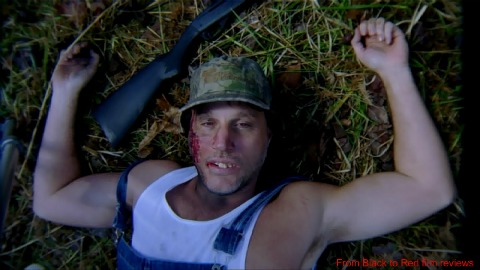

An oafish looking hunter named Billy gets struck by lightning and gains a new perspective on hunting animals for sport. Next a woman and man are being hunted in another stretch of woods by far more dangerous rednecks called the Loomis brothers, only to run off and get killed by a sniper. Oblivious, a woman named Christine and her pal Trey (director Ace "Friend Zone" Cruz) are headed out for the remote area to sell her late dad's cabin that Billy was a caretaker for. Two of their friends--a wild husband and wife--show up for a mini vacation that gets cut short for all when the Loomis brothers and mysterious leader Farragut--who were former inmates from the local military prison--tie them up and terrorize them. In the ordeal, Billy dies but his spirit comes out of his body to watch the events unfold. The remaining escape but have to fight for their lives in the nearby woods.


Billy's character frequently narrates overtop like a "Sling Blade" meets "Forrest Gump" with life's little lessons in between. "Sometimes life's like a seesaw. One minute everything is happy and fun. The next minute, it ain't." His pal, same exact actor from "Deliverance," doesn't speak but lets his banjo do the talking with a sixth sense for picking up pitches of people's emotions. There's a fine line between acting slow and coming across as accidentally comical in all the wrong places or just plain retarded if the performer doesn't create staying power or charm. Billy's character goes over the mark, which makes it a challenge to take it with any shred of merit. Especially since they made him such a typical hillbilly caricature with overalls and fake chompers to boot. It's possible they only wanted to be light hearted but he ended up being cartoonish at times.

Michael Madsen plays a condescending military man with nothing to lose. It's all sadistic fun and games as he torments and terrorizes his captives with little end goal in mind to make him more of a mad man--except like all diabolical villains he might have a surprise up his sleeve. Michael Berryman plays a faith healer of little words named Obeah who gives Christine a healing rock and advice about losing her fear or else she won't win the fight. Christine was kidnapped when she was younger and has a rage regarding it. Her father taught her how to survive and protect herself, which isn't always capitalized on here as she runs more than fights.


This can make one's head spin as it's both a conflicting story as to what to feel or where it's headed next but then at other points it's treated so simplistically as to hold the audience's hand with a quick and lazy narration overtop about who, when or why. This tries to do a different type of thriller/survival film, though a share of the characters don't feel real to life but just thrown together for contrast's sake. Not to mention the sequences of events are told in such an awkward way as to lose the viewer in subtext over and over again without giving a break for breathing room. It has heart and loads of ambition but the lack of resources and power to pull everything off. It threw together far too many clashing tones without measuring them out or giving time for a steady focal point; the various musical cues--from old-fashioned to modern--didn't exactly help bring it together either. Its attempts at trying to make this serious and tongue-in-cheek at the same time falls flat. The experience makes one feel detached without a stable mood to latch onto.

There are some messages that deal with violence and how hate can destroy a person by following them around if they don't let go. Despite not working entirely, the story does come full circle for all those involved, so there's some meaning for the viewing experience instead of just going with a throw away film with superficial action moves and violence; it's a good thing as the action choreography usually consists of them running from place to place--sometimes tripping--without always giving a challenging cat and mouse chase.

The verdict: the film never manages to slow its ambitious heels to make the overall experience move at the same time as the audience instead of getting too overexcited and running ahead.

Rating: 2.5/10

Director: Ace Cruz (Fate, Desert of Death)
Stars: Paulyd, Katie Fountain, Ace Cruz, Natasha Lyonne, Michael Madsen, Michael Madsen, Michael Berryman
Link: IMDB

Sunday, September 11, 2011

I Am Alive (2010)

Like ants placed in the middle of an ice box

Since two motion pictures, A & E, PBS and National Geographic have jumped in after the newspapers and best selling books, The History Channel gives it their turn surprisingly with a formative take even after all of the documentation before it. This time around the main perspective comes from Fernando "Nando" Parrado who played a key role in the Andes plane crash of 1972. The Uruguayan Air Force Flight 571 involved 45 passengers, including a team of rugby players called The Old Christians and other family and crew, who were on their way to Chile with no danger in sight until the pilot makes a grave error that caused everyone involved to make impossible decisions to hang on for survival in a weather stricken region with no wildlife or vegetation in sight.

A share of the tone of this documentary is somewhat calm and relaxed and more text book at first than other mediums that have concentrated on putting the audience in the now from a dramatic side. Towards the latter half with Nando and Roberto going through the mountains, they can't help but tell the story with straight feelings, as that's all they had to back them, apart from their skin and bones which nearly gave out. Both of the segments from A & E's "Minute by Minute" from 2002 and National Geographic's "Trapped" from 2007 tried to do the subject in under an hour by concentrating on the main portions of action, but still didn't give a completely thorough approach or show exactly how they got to each one of their motivations apart from jumping dot to dot. Those served more as introduction pieces to further the ambitions of upstarting TV shows and point to another medium. Though "I Am Alive" stands on its own by being thoroughly researched, even if you've seen the other documentaries on the subject. It doesn't seem forced with distracting poetic license or snazzy filmmaking. While they still give some brief reenactments, this focuses on getting a clear perspective from facts and fine details with passionate interviews from the survivors and related experts who still find the experience endearing and engrossing this many years later. This includes mostly spoken English with some overdubbed Spanish.

"I Am Alive" unfolds like a picture book with a share of information and visual representations of the accident and the 72 days that followed. While moving "Stranded" documentary from 2007 focused on the spiritual bonding of friends and how they viewed their situation from an emotional context, this is by far out of the documentaries that I've seen the one that gives the most clear and concise technical understanding. For instance, precisely how and why the plane crashed. There are even diagrams with historians telling their track record. "Of the 78 Fairchild FH-227s built, 23 crashed, and there were a total of 393 fatalities." There are real life pictures of where they hit the mountains, and then CGI graphics to show how lucky they were to land just so to have not made a sudden impact and disintegrated. The surrounding area is shown of exactly where they ended up on the side of Argentina, not in Chile like the pilots anticipated.

As the events come up, the experts give facts about head injuries, starvation, avalanches, inventing devices from supplies, traveling through the Andes and mountaineering. A climber and a team went back to cover some of the same distances Nando and Roberto did, which took them 10 days and 37 long and hard miles till they seen green. Photos were taken of the road that Roberto saw from the top of the first summit that they argued about at the time if they should head that way, but at that point being lost, unsure and hungry and then making the wrong move could have been life or death. I found it interesting that they discussed if they went east towards Argentina instead of west towards Chile if their chances would have improved. In the after author Piers Paul Read talks about his book "Alive" and the fear from the survivors of how it would be written after all of the sensationalist press around the globe.

What's mostly effective about "I Am Alive" is they weren't frequently making justifications for their actions after the fact. Nando carries the bulk and speaks somewhat unscripted as if he knows the story like the back of his hand. At times they still speak their piece, such as Nando calling what they did "anthropophagy" rather than cannibalism, since it didn't follow murder. At other times he speaks rather candidly, such as explaining that the avalanche saved the remaining people's lives due to it covering them from further storms, and then incidentally taking 8 more bodies that they used for food for the remaining days till they could trek out when weather conditions improved. It says a lot for him and the 15 others, but not so much for those that didn't make it out. It does state some facts a little directly and somewhat coldly as a result, though, on the other hand, it leaves room for the viewer to decide their stance. What makes this work is it's capable of uncovering more answers from stepping back somewhat and not making this completely a heavy hitter that "Stranded" already did so well.

Rating: 9/10

Director: Brad Osborne
Link: IMDB

Stranded (2007)

United in the Andes

Native Uruguayan director Gonzalo Arijon, who later located to France, was friends with some of the survivors from the 1972 Andes plane crash where only 16 came back alive and many others were lost over the course of 72 grueling days. With his "Stranded" documentary celebrating 35 years since the devastation turned miracle for some, he's capable of getting the survivors to open up--in their mother tongue of Spanish with subtitles--much more than on past documentaries. However, even this many years later, they still get choked up when talking about certain people or scenarios. Each of them gives their own varied interpretations, yet compared to "Alive: 20 Years Later" from 1993 it follows a more gradual flow along with a time line to keep it focused and capable of growing from the outset with a viewer latched on to each word and picture of their harrowing story.

This moves fairly steadily at first before the passengers make it to the plane as if it's just another day, despite the superstitious date of Friday the 13th, in October no less. As it progresses, it cuts to longer shots to get a contemplative grasp as well as a down and close perspective of the situation and time period of the early '70s in the surrounding region of South America. There are some current still shots with individual survivors, brief past reenactments and various shots of them with friends and family today. Some of them return to the area of the site and see it differently now from an older set of eyes, yet can still recall exactly what they felt at a particular moment like it's seared into their head. This begins with various points of views before even getting on the plane, from one feeling like something was going to happen, to another thinking everybody looked their happiest. They speak about those that didn't make it as if it was only yesterday in either what they were doing prior to the crash or what they had planned when thought to arriving in Chile. It gives a look at their moment-by-moment thought processes and how they struggled to react to it all and attempt to grasp exactly what's going to happen next. Some kept to themselves, while others jumped in to help as if by second nature. However, as it moved along, they eventually viewed themselves as a sort of "new society" that had to do unfamiliar things that they wouldn't have done before, along with the fuselage feeling like their home away from home, partly because with failing health they had no strength, never mind stepping out to use the facilities or to leave.

They went through a varied range of emotions from the outset, as each day they didn't know if it was their last. They got to the point where they accepted death and realized it would have been an easier way out. There were some black and white pictures taken during the ordeal where some smiles are on their faces despite. Out of boredom, there were even some bets and verbal guesses on who would die first. Some pushed away feelings to go on with determination, while others gave up and it lead to their deterioration. It seemed like everyday was different, with some having strength at one point and at another losing hope, but so long as they had a support system to stay united they could carry on. Today some have guilt about why they made it and others didn't, as it was completely random as to what happened to whom. Their outlooks after the fact can be somewhat philosophical and give something deeper to learn from watching this. Then, on the other hand, this can be candid at times, from including more details about the cannibalism portion of their survival, to even mentioning that they made powder out of the bones for calcium because they were low on essential vitamins and nutrients. They speak of having to hit and pound on each other to improve circulation or else the cold could consume them, or having to rotate or stack themselves for warmth.

Some things are included that weren't shown in the "Alive" film, such as the search effort from the surrounding countries and parents that wouldn't give up, as well as the factors of why it didn't work. A few aspects also differed, such as one of the other people mentioning eating the dead first, as well as a few people at once eating a small amount at the same time. After the avalanche they also had to eat their friends around them that just died since the other bodies were outside. In my own personal view, I feel the avalanche stands out as one of the worst of the scenarios, since they were already down and struggling and yet another accident took more people that initially survived the crash, weather and hunger before that. Though it's interesting that a few describe their near suffocation almost serenely, which I would have guessed would have made me feel trapped and helpless, but then coming to might be more hellish than those few moments of pain till the beyond.

From a filmmakers stand point, "Stranded" is capable of changing up into different modes, locations and interviews with ample time to get an overall feel of what happened without skimping or glazing over important areas. It's not grand on past reenactments, but, then again, it gives you a visual for context and leaves the cinematic experience for the movies "Supervivientes de los Andes/Survive!" and "Alive." This concentrated on bonds and emotions, rather than being flashy or coming with a filmmaker's signature. This was emotionally capable without being overly manipulative--bar slow pianos and extended strings--or even having to show the people break down on camera to get the message through. It puts the harsh realities into their place without always holding back, though still with respect to the other families and their friends, as a share live in the same area and word gets around for those that are trying to forget. This shows that they got bombarded with news stories--some sensational, some compassionate.

"Stranded" portrayed what took away their hope and also what gave them strength, such as their families back home, present friends and faith to give them a crutch to go on. There's something to learn here despite their circumstances being a special case that would more than likely never be repeated again. This was documentation at its finest, and stands as the definitive audio and visual experience of the Andes crash in 1972 at this point, even over both movies, which serve mainly as mere introduction pieces compared to the amount of information here.

Rating: 10/10

Director: Gonzalo Arijon
Link: IMDB

Saturday, September 10, 2011

Alive in the Andes (2007)

A stylized retelling

This was fittingly the first episode for a National Geographic television spot with episodes that ran under an hour that focused on disasters that involved people who were "Trapped." Those involved in the Andes mountains plane crash back in '72 carrying a team of Uruguayan rugby players along with other passengers, weren't trapped in an enclosed place with walls, but still locked down to a certain area by harsh weather conditions in a remote terrain with no wildlife or vegetation.

This is a high-octane version of the events that lasted 72 days in below freezing temperature, with a share of flashy filmmaking techniques to amp up the juices. Forty-five passengers get quickly dwindled down to sixteen and makes the Andes look like a serial murderer, with crude medical terminology to study its unfeeling ways. The reenactments--with English spoken with American accents--coupled with loud sound effects and bombastic performances hit the viewer with force as they over-emphasize to grab your attention by being the loudest person in the room. To its benefit, from what starts out in the viewer's face somewhat cools its heals and extends a few scenes to get some thoughts and emotional contemplation in about their impossible situation and what they had to endure. Though this still concentrates more on the action and movement of what they went through than always about the friendships, bonding or spirituality of what they felt, which ultimately helped them make it through. However, it did show the lengths Carlito's father went through despite it being a plane crash with record weather conditions and a number of days since. He felt his son was still alive and it was truly captivating by showing the other side of holding on to those that matter most.

This is challenging story to tell in under an hour's time frame for one of the most harrowing tales of survival in the last century since a share of landscapes turned into concrete jungles. "Trapped" did handle the events with more depth than A & E's "Minute by Minute" episode from 2002 titled "The 1972 Andes Survivors." Instead of learning from a spiritual stand point like the documentary "Stranded," that also came out in 2007, this takes educational facts about their surroundings with alternate scenes of CGI that shows a transparent human body, such as hypothermia and dehydration, and then what they had to do to overcome those obstacles. Still, there are chunks that are missing. At one point it's going with a day by day analysis, which helps to reasonably work up to why they had to eat human flesh for sustenance than sensationalizing it, then skips from Day 17 to 43. What's disappointing with a share of "Trapped" was it took an event from 1972 in South America and attempted to translate that to audiences nowadays. Though it feels like it carries more of the modern times than how those people lived or what was going through their heads that was relative to the year. It feels somewhat hip and trendy to 2007, and carries more a style and trademark from the filmmakers to the point of being distracting in areas from those originally involved. The narration adds flavor and includes a characteristic voice, yes, though it still seems out of place with his flamboyant, oddly syllabified proper English.

Rating: 6.5/10

Director: Tim Wolochatiuk
Link: IMDB, video on Youtube

The 1972 Andes Survivors (2002)

A pep-me-up retelling

This was a 45 minute spot from a TV show called "Minute by Minute" that ran from 2001-2002 on A & E. This recounts the story of the Andes survivors, from before the original 45 passengers stepped onto Uruguayan Air Force Flight 571 destined for Chile all the way up to when the 16 remaining made it back home from two members of their party trekking over the mountains from rescues being called off. This is a good starting point if you've never heard of the events before, or only in passing and want to know more in 45 minutes.

This was a snappy retelling with the intention of getting a viewer's heart racing to see what happens next, rather than being thoroughly informative despite the show's title of "Minute by Minute." If you've seen either the films "Supervivientes de los Andes" or "Alive" or even read one of the books, this isn't going to say very much that's new, except to possibly show them at the 30 year mark still alive and living life to the fullest is captivating in itself. I did find it interesting to note that they didn't go straight from Uruguay to Chile, which some of the other retellings show, but had a layover in Argentina due to the weather conditions, but then proceeded forward the next day anyway. The meat of what they went through is here (no pun intended) with quick edits and clipped narration with a steady flow of information to get charged by. Though for an emotional context, this doesn't always leave room for the characters to truly open up, since a specific person never says more than a few lines at a time, rather than to give a brief and succinct factual version of their account with frequent time lines displayed on the screen for that "Minute by Minute" touch that makes it feel too planned and not translate that everyday was unsure as the last.

This only gets a few perspectives of the account. It has spoken English interviews with Roberto Canessa, Canessa's girlfriend Laura Surraco, Fernando "Nando" Parrado, Carlitos Paez, Coche Inciarte and Inciarte's fiancee Soledad Gonzalez. Dubbed English with General Jorge Massa (Chilean Air Force), Carlitos's father, Father Andres Rojas and Dr. Jose Ausin (first doctor to examine them). There is still enthusiasm to tell their tale even after 30 years at this point. Though this isn't a story that can be effectively told in a short time frame, since major events don't happen one after the other. They went through 72 intense days with an array of emotions to battle, one of them being that they didn't know if they would live or die tomorrow or after going to sleep. What actually happened to them is more a slower crawl till the light at the end of the tunnel, than the usual survival in the wilderness story where you can put emotion on the back burner to stay alive. On the other hand, for a viewer who gets touched fairly easily, the tone here is kept somewhat upbeat and hopeful in most areas, despite what the survivors have stated they felt on other days in different interviews. I guess that shows what the power of editing can do.

Rating: 6.5/10

Link: IMDB, video link Youtube

Alive: 20 Years Later (1993)

From up to 72 days to 20 years later

"Alive: 20 Years Later" is a companion documentary piece to the 1993 film "Alive" that fills in some of the gaps of what the movie couldn't slow down to show in a reasonable time frame. This is broken up with spoken English and some dub overs in Spanish, along with a narration courtesy of Martin Sheen. Survivor Nando Parrado speaks a majority of the time, along with some others such as the Strauch relatives as the time progresses.

Twenty years later and a share of the sixteen survivors look back on what was going through their heads and how it has affected them up till the present day of the early '90s. There's behind the scenes shots of the movie "Alive" that show Nando and a few others visiting the set as technical advisors. Actors of the film are only shown from a distance as the focus is more on the real life people. Though there are some brief interviews with the filmmakers in between. The fuselage that was built to recreate the aftermath of their accident is so accurate according to one survivor that it brings back instant memories. They fill in some of the gaps of the 10 day journey through the mountains that also involves the final rescue and knowing that everything was okay at that point. Some black and white photographs are shown in the after with faces buried in beards but smiles of elation emerging from underneath.

Many of the survivors live in the surrounding area as not only to each other but also the ones that didn't make it out. Even though the families are reminded with their presence, they have to be careful with what they say, as it can get around to someone who is trying to forget. Therefore, the bodies that were used or in what order are never disclosed. They speak about some divided views of whether or not it was right that they ate their friends to survive, which was hot on people's minds right afterwards. I mean, "Soylent Green" had a related twist that caused people to reel in their seats just a year later in '73; not to mention that point was only in the script and not in the prior novel. Their priest gives his thoughts of the events, along with some who did the act and how it affected them, or whether they would do it again. There's honesty here with admitting to not being as strong and then others who did more not wanting to be considered heroes. No one wanted to be there but they made the best of it and use it as a growing point to live on. It's an inspirational story that shows how much spirit a group of human beings has. Most of us never had to do even a fraction of what they did, and probably will never have to, so it's something to hold in the back of one's mind as a reminder.

As a definitive documentary, this doesn't capture everything. Though as a piece to give a sampled overview of the events, "Alive: 20 Years Later" works in that regard as it gives out various snippets of information and shows some visuals of the then and now. The behind the scenes of "Alive" are only briefly covered and none of the performers spoke of how the role affected them or how they prepared, nor how it came to be made into a movie again. Also, some sections feel like they're too compacted and succinct to give room for contemplation or to feel the emotional impact. This is told somewhat out of sequence and with some roving thoughts pertaining to the events, which doesn't always make it progress or grow from the outset when it jumps back and forth. This is relatively brief and sometimes to the point in areas like either the filmmakers or the interviewed have somewhere else to be. That or the editor went a little overboard or they had to fill only a select time frame since it clocks in at around 50 minutes. There are still some interesting tidbits that aren't in the "Alive" film, nor "Supervivientes de los Andes/Survive!" from '76 based on the same events.

Rating: 6.5/10

Director: Jill Fullerton-Smith
Link: IMDB

Thursday, September 8, 2011

Alive (1993)

Perseverance in the face of an accident

This was based on real events about survival and holding on when an impossible event, that includes friends and loved ones, causes others to make decisions and sacrifices that they would have never done before in their comfortable lives. "Alive" wasn't made to be an action/adventure story in the wilderness but more of a drama that concentrates on the people and the emotional impact of how far they had to go to hang on.

In 1972, a plane carrying a Uruguayan rugby team and other passengers are passing through the Andes mountains for a match in Chile. Everything is fun and games with the world in the palm's of their hands, until they choke up when going through a rough patch of weather. Before everyone knows it, it's the real deal as the vision of the pilots gets blurred by the atmosphere and they clip a mountain top before crashing into the freezing, snow covered terrain. A share of the passengers flew out of the plane before impact and then there are those that are injured or dead when they abruptly stop, luckily without explosion (see Hollywood, not everything is combustible), but still with a wrecking impact of toppled seats and contorted passengers. Various wounds and psychological trauma runs rampant and those that are better off scrounge up supplies till they can get rescued. Communications are out, temperatures drop at night and food is scarce among the remaining at that point who use the somewhat intact fuselage as a shelter.

The captain of the rugby team, Antonio (Vincent Spano), keeps everybody together with a game plan and reassurances, until matters get worse when they think they're going to be rescued and the remaining food is quickly gone through. Roberto (Josh Hamilton), who was attending medical school, acts as stand in doctor after their team physician died, along with his wife. It becomes a test of human will and endurance as the days pass by with little hope in sight but what they make of their pitiful situation. They see how hard it is to trek even a small ways as young and athletic as they are. A man named Nando (Ethan Hawke) isn't taken seriously at first when he boasts that he's going to go out on foot and then eat the flesh of the dead pilots for sustenance because they were the ones that got them in the situation in the first place. Desperation hits with bad news from a hand held radio. Nando tells all his proposition and it's taken mostly with disbelief and derision. "I don't think I could do it. How could we go back to our families?" "You could go back alive. I think they'd prefer that." "...are you ready to go out there and cut flesh from a human body and eat it?" "It's like communion. From their death, we live."

The story and events gradually unfold as you get a feel for the passengers. The simple things are shown as they bide their time with song, prayer and idle talk to stick together as a unit. This comes with some emotional scenes but it didn't seem like they set out to make this a through-and-through tear jerker. There's some humor and other areas where they have to push their feelings aside for the time being if they want to keep going. They first go through a crash, battle starvation and then if that wasn't enough combat acts of nature. A few take a trip to retrieve a battery from the detached tail end to get the radio working to call for an SOS. Though the repair work was harder than it looks and this time they plan out an impossible journey with only makeshift equipment and a desperate hope to get help for the rest who are deteriorating in health and spirit.

Their English at first might seem somewhat formal in areas, but my guess is that they phrased sentences how it would be closer to Spanish. Thus despite U.S. actors, they didn't include any blatant Americanisms in their speech. Still, some parts come off as a little forced and unnatural when trying to convey the array of emotions that the real people felt, but, on the other hand, I'd imagine it's better that the actors performed somewhat unpolished to show spontaneity to the situation rather than going with clipped dialogue delivered from a comfortable movie set. They didn't lose sight of the real events with a distracting amount of poetic license--even though there are some aspects glazed over for the sake of narrative as well as handsome and recognizable actors in place of the real people--it sticks close to what happened. The rescue attempts aren't shown and it's kept focused on the people at hand. The '70s version "Supervivientes de los Andes" used a framing technique to show the government working to find the plane, but it was spaced so far apart to lose its driving power. The after isn't shown beyond a brief but rewarding scene, but, then again, it shows them as a connective group by my guess to not single anyone out as a lone hero--for which Nando in real life says he's not--not to mention this is a means to point a viewer towards another medium and serve as the audio and video introduction.

There are some enthralling shots of the scenery with a landscape that has seen countless days, months, years and seasons, as well as generations of species pass by and still to continue going on well past the mentioned's lifespan. It goes to show that nature can be both beautiful and treacherous, even when people are caught in the middle. It makes no judgments, which gives thought to wonder if it should be studied, feared or awed--probably a combination of all of the above.

Rating: 7.5/10

Director: Frank Marshall (Arachnophobia)
Stars: Ethan Hawke, Vincent Spano, Josh Hamilton
Link: IMDB

Wednesday, September 7, 2011

Supervivientes de los Andes (1976)

No vegetation or wildlife...just your amigos

Based on the book "Survive!" from '73, this was a Mexican made film that quickly jumped in for the cinematic experience of real events that happened just four years prior in '72. The story involved a group of people that after an accident had to make impossible choices for their survival that they would have never done otherwise. To take that even further, this was a special set of circumstances that would more than likely never be repeated by someone else again. Both this and the much bigger budget version of "Alive" in the '90s show how the main events occurred similarly, with some minor scenes emphasized more than each other. However, "Alive" was the more dramatic and captivating version for the visual experience and for an introduction to how some of these people made it out to tell their harrowing story. "Supervivientes de los Andes" didn't capture the full effects of the events, with the exception of some grisly bits that were amped up in marketing tactics for the U.S. dubbed version called "Survive!"--which has a different running time and some other alternations. Shock value sells, and it makes you wonder about "Soylent Green" coming out a year later after the Andes' events with its final twist that wasn't in the original novel it was based on.

Goodbyes are said at the airport with a group of young rugby players and other passengers from Uruguay on their way through the Andes mountains in South America. There is some foreshadowing dialogue in the beginning as if the characters had an intuition for what's to come; that or for a wink-wink to those who already know the story. In the air, weather conditions and confusion on both of the pilots' behalves causes them to crash into a remote area of the mountains where there isn't any vegetation or wildlife and the temperatures are freezing if that wasn't enough. A share are dead, others are injured and the rest try to overcome the harsh and snowy conditions with little provisions. They attempt to stay warm in the remaining portion of the plane, though get at each other with in fighting, until they realize they have to stick together as a union. What originally started with 45 passengers at the outset begins to dwindle with lack of food and slim chances of a rescue attempt. They're losing hope and starving, though soon enough one of them propositions they eat the meat on the dead bodies so as to remain alive.

The avalanche scene--which killed more of their party and in real life caused them to be held up for a few days--in the movie is over and done with in an abrupt and brief scene, causing it to lose much of the impact and then only revert back to shots of cannibalism. I found it to be one of the more emotional scenarios they had to go through because they were so beaten down by that point that it caused the remaining survivors to reevaluate their chances all over again. Their health is failing and they realize a trek with a selected strong few is their only chance out to save the rest. Towards the close it gets a little too drawn out with anticipation before the final pay off. After seeing how down and desperate they were beforehand, the viewer is dying to see some resolve by that point. There's a framing technique with alternate shots of a rescue attempt, not just to detail that they tried, but to make it somewhat of a driving point. However, it comes off as anticlimactic with too much space between the shots of the survivors to put the audience on the edge of their seats.

What's disappointing here, is a share of the transitions between events feel as if they're laid out like a formulaic storyboard, while missing out on some of the emotional impact of the real occurrence or even how they got from one action to the next. In theory, things are bleak and hopeless as they sit around, but it feels like watching this from a distance with the screen still blocking contact between you and the characters. Sometimes the performers don't feel as individuals rather than a general group, therefore there's more concentration as an overview than on specific character's thoughts or their interpretations and motivations. Watching this now or in '76, doesn't always do more than a written account, as the audio and visual cues to translate the events aren't always done justice here. There aren't any memorable performances as a result that stick out--with the exception of the fathers trying to hold on despite not being extensively shot--or even stand out acts of the dramatic, and it can make the story turned into the cinematic experience feel somewhat flat. The production values range from makeshift to just meeting the grade. It comes with some model airplanes to make one stretch their imagination, as well as not so convincing snow sometimes thrown this way and that when they're filming the fuselage on what looks to be a sound stage with actors missing icy breath. Other shots of the surrounding outdoors appear to be filmed on location and give it more of the realism of being there in the barren surroundings. This has some stock sound effects, such as a looped wind effect that becomes tedious after a while, and even some cries from the characters are overdubbed.

This is kept simple in some areas, yet it switches over to show some candid shots of eating flesh of what's supposed to be humans, not to mention cutting it off and laying out strips so the survivors can economically munch their portion. My guess is to curb fighting over it and keep it civilized. It's somewhat shocking as the camera doesn't pull away even when the point is made, but they also didn't kill to eat or do it in a way that's rapid, which makes it more an act of human will to hang on for life and see your loved ones on the other side than something outright animalistic. From being backed into a wall, they were still conscience as to what they were doing to make it out: from first the plane crash without falling out or exploding, to the weather conditions, to their own bodily functions failing, to then having to trek through mountainous terrain. To point out, if any one of the those situations failed, they were dead, so focusing on the cannibalism portion does feel somewhat leaning towards sensationalism, though I'm sure the investors had to sell tickets for the morbidly curious.

Rating: 4/10

Director: Rene Cardona (Night of the Bloody Apes)
Link: IMDB

Sunday, August 7, 2011

Prowl (2010)

Look it's a bird, it's a plane...I don't know what that is

This starts out like a coming-of-age drama with a young woman named Amber who's sick of small town life in Famfield despite her close friends, mother and part time job. There are some unexplained snippets with ominous visions that include people chasing her and decomposing bodies. Is something calling her, or is it just the stress and mounting pressure of cabin fever? She wants to move away and get her own apartment in Chicago but first she has to get there with a deposit before another prospective tenant. Her five friends tag along for the road trip, until right outside of the city limits their car breaks down. As chance would have it, a friendly semi-truck driver pulls over and they beg him to take them to the windy city, but not before telling him they want to snap his picture, that one should ride up front and, of course, their family should know who they're with for safety's sake. Can never be too careful, or can you?

They hang loose in the back cargo area by playing games, drinking and smoking drugs. Suddenly they take a nasty swerve and get thrown about. They call the driver and he gives them the run around to stop, which makes them suspicious enough to call 911, though where they just entered the signal doesn't go through. The driver backs into a loading area of an abandoned warehouse that looks like it used to be a slaughterhouse. After the back door opens, everything turns into chaos when they step out into the factory with no visible way out and strange creatures who fly through the air, crawl on the walls and want to consume their flesh sooner than they can rip it off. From then on out it ends up being something like "The Most Dangerous Game" as these victims are treated like not only lunch but challenging sport.

"Prowl" is a director's film first and foremost. It has a steady pacing that keeps up a certain element of mystery without laying out a full view of its blueprints, as well as it manages to escalate the story to different levels while still slowing down in a few areas to catch its breath and explain. The dialogue also dances around and doesn't lay it all out for the audience, which gives it some challenge and curious questions even after the credits roll. It manages to cover up its plotholes--sometimes after the fact, which makes you wonder about a few in the meantime--such as certain physicalities. It gradually unveils the blood-craving beasts from quick shots to extended, which keeps a viewer guessing as to what they are and what it all means while--thank the horror Gods!--doesn't fold in on itself and make what they have going too cheesy. This is more intriguing and mysterious like a thriller than it is continually scary like a horror, though there are still a few jumping shocks used to rile one's pulse, even if not terrifying.

What at first seems like it's only prolonging the inevitable, comes full circle and turns into a tale of finding out what Amber's life means before she even gets to her promised land. The blood is more watery than the truly crimson looking stuff and there are frantic camera shots that go a little overboard. Though this was a quick, basic and entertaining piece that could have been a run-of-the-mill movie with different direction, less measurement and passion put into, not to mention it's a simple story that only has a few conventions tweaked around and isn't the most original out there, but the way it carried itself was turned into an effective experience that urges forward. One where it's a little more unexpected than other don't-take-rides-from-strangers fare.

Rating: 7/10

Director: Patrik Syversen
Stars: Ruta Gedmintas, Courtney Hope, Joshua Bowman, Perdita Weeks
Link: IMDB


10 things to learn from "Prowl":

10. Guys with glasses never get the hot girl, Clark Kent included.
9. Abstinence from sex = survival in a horror tale
8. It's cheaper to shoot a film in Bulgaria, as it's cheaper to make products in China.
7. You can fly without wings.
6. You can leap highly without frog legs.
5. Women have ass kicking abilities too.
4. Don't do drugs while taking rides from a stranger, as it will only make things stranger.
3. Don't trust nice guys--they're often not so nice.
2. Stay put in the same town, as it's safer.

And finally:
1. Don't take rides from strangers--ever!

Stag Night (2008)

Modern day cavemen in NYC

This opens up with a bloodied woman running away from "something" in the terminal of a subway station only to be slaughtered with no one to hear her desperate cries for help. Now, four guys in the wee morning are celebrating a bachelor party at a strip joint when they get kicked out and head for another club by using the subway to get there. They catch two ladies on the train from earlier--one drunk and ditsy, the other confident and collected--and try to continue the party up until one of the woman gets fed up and uses pepper spray on the unruly brother of the polar opposite nice-guy bachelor. They all step off to clear their eyes, when suddenly the nonchalant operator takes off and leaves them stranded.

The terminal exits are locked, there's no cell phone reception and even if another train comes through it won't stop. Four of them head up the tracks on foot while a man and woman stay behind to get a little frisky--yes, the filmmakers went there, partial nudity to boot. Soon enough they realize they're in danger when three modern day cavemen looking vagabonds brutally kill a cop after he catches them raiding a vending machine. The villains end up being one-note savages who's stench alone could make one keel over, who are so dirty they look like they have permanent tans, who's obnoxious growls could make any wild beast run with tail between legs and who's skin is so greasy it could be bottled up to make everlasting Jheri curl solution. From what was initially just a time-killing mistake turns into a killer game of hide and seek till they can come up with a plan to get out safely, including manning and womanning up to fight back as these tunnel dwellers are far from lethargic pushovers looking for a handout but skilled warriors that like to taunt their opponents for the challenge. Now, it's explained that their situation and the groom to be have a coincidental connection in that bachelors some ages ago would be sent out for the night to hunt a stag to prove they could survive the test and provide for their families.

"Stag Night" doesn't even try to be great. The acting is adequate if not award winning. It's more unintentionally funny in some areas than scary despite some foreshadowing and other sections that attempt to stack tension. It uses excessively frantic camera shots to translate the action and fight scenes, but instead cause more hangovers than palpitating hearts. Sometimes the music seems independent from the film with attempted build ups to translate an atmosphere that seems nonexistent. This is a purist horror film that relies heavily on conventions down to the finish line--though one that tries and keeps up and falls short of even breaking through the ribbon. But let's face it this is a one-off movie for rowdy group gatherings that everybody can half pay attention to or wildly talk over, as other classics have been outlined better, came with more interesting characters, had villains that were more mysterious and menacing, or just included more inventive death scenes even though this does produce some decent blood shed and gore. On one hand you can count on it but on the other there's not going to be a ton of things to write home about afterwards. One thing in its credit is the story is pretty straightforward, which isn't always a bad thing as it had its share of plotholes but didn't get entirely confusing or overly ambitious. It sticks to its tried-and-true guns, even if those guns are somewhat dull and worn thin.

Rating: 3/10

Director: Peter A. Dowling (writer "Flightplan")
Stars: Kip Pardue, Vinessa Shaw, Breckin Meyer
Link: IMDB


10 things to learn from "Stag Night":

10. New York looks awfully like Bulgaria.
9. Cell phones have to be explained in every modern horror movie.
8. Brothers don't always look or sound alike.
7. Neanderthals never went extinct.
6. Strippers read.
5. Mannequins watch TV too.
4. Women fall for the nice guy, not the jerk--right.
3. Kids aren't so cute.
2. Never let your guard down before the finish line.

And the most obvious one of all:
1. Never step off a train before your destination.